Fencing and Garden Boundaries in Wombwell, Dodworth and Darfield: What to Check Before Your Fence Goes Up
Planning garden fencing installation in South Yorkshire? We cover what to think about before you start, from post depth to panel choice, across Barnsley, Sheffield and beyond.

Garden fencing in South Yorkshire is not just about privacy
A fence does several jobs at once. It marks a boundary, keeps children and pets safe, blocks the worst of the wind off an exposed South Yorkshire plot, and finishes a garden off so it looks considered rather than thrown together. Get it right and you barely notice it. Get it wrong and you are looking at a leaning post or a lifted panel every time the weather turns.
We fit fencing right across South Yorkshire as part of our wider landscaping work, covering Barnsley, Sheffield, Rotherham, Wombwell, Hoyland, Penistone, Dodworth, Darfield and the villages in between. This article runs through what actually goes into a solid fencing installation, what goes wrong when corners are cut, and how to think about the choices before we turn up.
Why post depth matters more than the panel itself
This is the one thing that separates fencing that lasts from fencing that leans. A wooden fence panel is only as strong as the post holding it, and the post is only as strong as what is happening underground.
The general rule for timber posts is that roughly a third of the total post length should be in the ground. So a six-foot fence needs a post that goes at least two feet down. On clay-heavy ground, which is common across a lot of South Yorkshire, you also need to think about movement. Clay shrinks in dry summers and expands when it is wet. A post set directly into clay without a concrete surround will shift over time.
We set posts in concrete as standard. The concrete collar needs to slope slightly away from the post at the top so rainwater runs off rather than sitting around the timber. It sounds like a small detail. It is not. Standing water is what rots a post from the base upward, and by the time you notice the lean the damage is already done.
Choosing the right type of fencing for your plot
There is no single answer here because plots vary enormously. A garden in Penistone on a hillside needs different thinking to a flat terraced plot in Wombwell. A few things to consider:
Closeboard (featherboard) panels are the workhorse of garden fencing across South Yorkshire. Individual boards overlap slightly and are fixed to arris rails, which means the fence stays reasonably intact even if one board splits or warps. They handle wind better than a solid panel because there is a small amount of flex in the structure.
Lap panels are cheaper to buy but they are essentially a single sheet. In an exposed or elevated spot, a lap panel acts like a sail. We see a lot of them fail after a single winter storm. They are fine for a sheltered, low-wind spot but we would always steer people toward closeboard on anything exposed.
Wooden posts and gravel boards are the combination we almost always recommend for timber fencing. A gravel board sits at the base of the panel, keeping the timber off the soil. Soil contact is what accelerates rot. A gravel board takes the damage instead of the panel, and it is far cheaper to replace a gravel board than a full run of fencing.
Metal post supports are sometimes used as an alternative to concreting posts directly, but on South Yorkshire's heavier soils they can work loose over time. Direct concrete setting is more reliable for a permanent installation.
Sloping gardens: fencing on a gradient
A lot of South Yorkshire gardens slope. The ground around Hoyland, Dodworth and the hillier parts of Barnsley and Sheffield is rarely flat, and fencing on a slope needs a different approach to fencing on level ground.
There are two options: stepped fencing, where each panel drops in a step to follow the gradient, or raked fencing, where the top of the fence follows the slope continuously. Stepped fencing is more common with standard panels because panels are rectangular. The gap that appears at the bottom of each step can be filled with a shaped gravel board or a small section of closeboard.
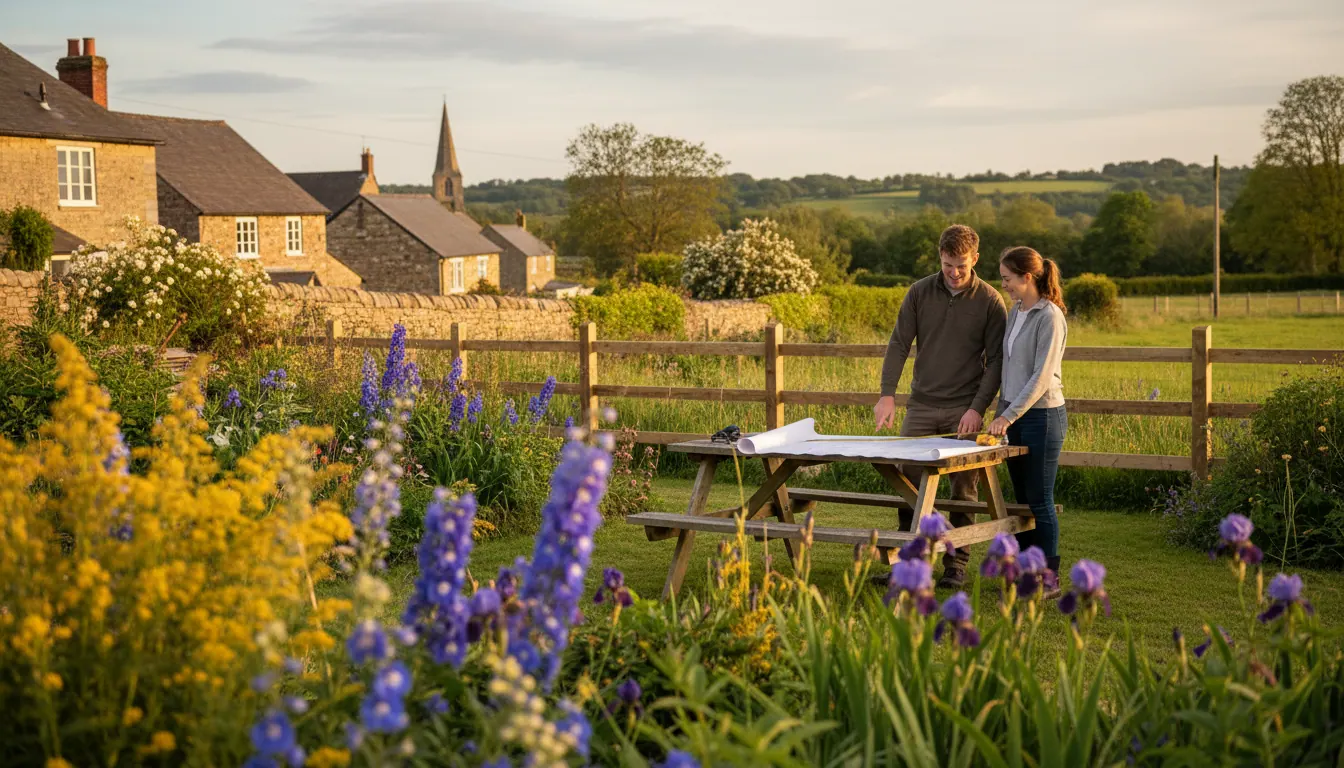
Getting this right requires measuring carefully before a single post goes in. We take the time to set out the line, work out the falls and plan where the steps will land. Rushing this stage leads to gaps, misaligned panels and posts that end up at the wrong height.
If your garden has a significant slope and you are thinking about terracing or raised sleeper beds alongside the fencing, it is worth looking at our article on sleeper raised beds and terracing on sloping gardens across South Yorkshire for more detail on how those two elements work together.
Treating and protecting timber fencing in South Yorkshire's climate
South Yorkshire is not the driest part of England. We get proper winters, persistent damp, and the kind of driving rain that works its way into untreated timber quickly. Any timber fencing we install should be pressure-treated as a minimum. Pressure-treated timber has preservative forced into the wood under pressure, not just painted on the surface, so it resists rot from the inside out.
Even with pressure treatment, a coat of fence treatment or stain every couple of years will extend the life of the timber considerably. Pay particular attention to the top edges of boards and the tops of posts, which are the first places water settles.
Post caps are a simple addition that a lot of people overlook. They sit on top of the post and stop water sitting in the end grain, which is the most vulnerable part of any piece of timber. They cost almost nothing relative to the fence as a whole.
What our customers say
Julie Warriner came back to us after we had fitted her bathroom, this time for garden work. That kind of repeat business is something we genuinely value. Here is what she said:
Paul and Malc made a beautiful job of our bathroom so we had them back to sort out our garden, we are so pleased with the work they have done for us. Fantastic guys, with excellent communication, would highly recommend!!!!
That sums up how we like to work. We explain what we are doing and why, we keep communication clear throughout, and we leave the garden looking right. The same approach we take inside the house applies outside.
Combining fencing with the rest of your garden project
Fencing rarely sits in isolation. Most of the gardens we work on across South Yorkshire involve a combination of things: a new patio or paved area, raised beds, turfing, levelling and then fencing to tie the whole thing together.
Getting the sequence right matters. If you are having a patio laid, the fencing line should be set out first so the paving can be cut to meet it cleanly. If you are having sleeper beds built against a boundary, the fence needs to be in the right position before the sleepers go down.
We do all of these things ourselves, which means we are not waiting on another trade to finish before we can start the next part of the job. That joined-up approach makes a real difference to how smoothly a garden transformation runs.
Frequently asked questions
How deep should fence posts be set in South Yorkshire soil? As a rule, roughly a third of the post's total length should be in the ground. For a six-foot fence that means at least two feet of post below ground level. On the heavier clay soils common across much of South Yorkshire, we always set posts in concrete to prevent movement as the ground shifts with the seasons.
What is the best type of fencing for a windy or exposed garden in South Yorkshire? Closeboard or featherboard fencing handles wind better than solid lap panels because the individual boards have a small amount of flex and the structure is more robust. On elevated plots around Penistone, Hoyland or the hillier parts of Barnsley and Sheffield, we would generally steer away from standard lap panels for anything exposed.
Do I need to treat pressure-treated fence posts and panels? Pressure-treated timber already has preservative worked into the wood, which gives it good baseline protection. Adding a coat of fence stain or treatment every couple of years, particularly on end grain and top edges, will extend the life of the timber noticeably in South Yorkshire's damp climate.
Can you fit fencing on a sloping garden? Yes. Sloping gardens are very common across South Yorkshire and we are used to working with them. Stepped or raked fencing are both options depending on the gradient and the look you want. The key is careful setting-out before any posts go in, so the panels align properly and any gaps at the base are dealt with neatly.
Get in touch about garden fencing installation across South Yorkshire
If you are thinking about garden fencing installation in South Yorkshire, whether that is a straightforward boundary replacement, fencing on a difficult slope, or fencing as part of a bigger garden project, we are happy to come out, take a look and give you a free quote.
Between us, Paul and Malcolm have over 60 years of combined experience in the building trade. We turn up when we say we will, we explain what we are doing, and we leave the site tidy. No job is too big or too small.
You can reach us on 07817 465504 or 07377 261581, or take a look at the full range of work we cover at P&M Home Improvements.